
In today’s poultry production, gut health has become the center of almost every nutrition discussion. With antibiotic growth promoters being reduced or removed, farmers and nutritionists are constantly looking for alternatives that protect performance without harming long-term flock health.
Two terms come up again and again: probiotics and prebiotics.
They are often used together, sometimes confused with each other, and occasionally expected to do the same job. But they are not the same, and understanding the difference can help you make better decisions for growth, immunity, and profitability.
Let’s break it down in simple terms.
Why Gut Health Matters More Than Ever
The poultry gut is far more than just a digestion tube. It functions as a complete system responsible for digestion and nutrient absorption, acts as a major immune organ, and serves as the first line of defense against harmful pathogens.
In fact, more than 65–70% of a bird’s immune activity is linked directly to the gut. When gut health is strong, birds digest feed more efficiently, grow faster with improved FCR, cope better with stress, and show lower disease pressure. This is why gut-focused nutrition is now considered the best poultry feed supplement strategy, rather than a mere optional add-on in modern poultry production.
Probiotics for Poultry: Adding the “Good Bacteria”
What are probiotics?
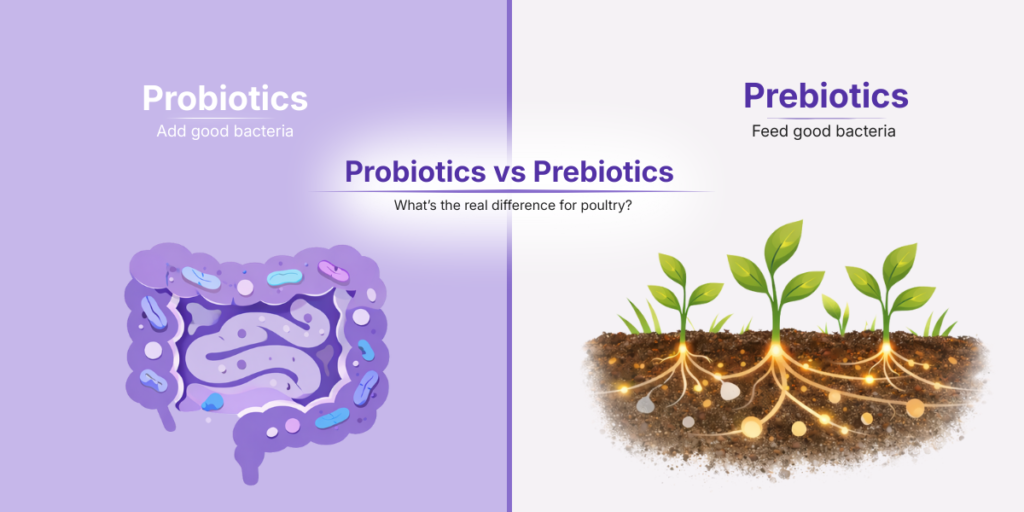
Probiotics are live beneficial microorganisms that are added to feed or water. When they reach the gut, they help restore or maintain a healthy microbial balance.
In simple words Probiotics add good bacteria to the gut.
A good probiotic for poultry works by:
- Competing with harmful bacteria for space and nutrients
- Producing natural antimicrobial substances
- Supporting digestion
- Stimulating local gut immunity
Because of these benefits, probiotics are widely used as a Non-antibiotic growth promoter.
Limitations of probiotics
Probiotics are living microorganisms, and their effectiveness depends largely on how well they survive practical conditions. They must withstand feed processing, remain stable during storage, and successfully colonize the bird’s gut after consumption. If any of these conditions are unfavorable, probiotics may simply pass through the digestive tract without establishing themselves or delivering their full benefits.
Prebiotics for Poultry: Feeding the Right Bacteria
What are prebiotics?
Prebiotics are non-digestible feed ingredients that selectively feed beneficial gut bacteria already present in the bird.
In simple words Prebiotics feed the good bacteria, instead of adding new ones.
A prebiotic for poultry is not alive. It is stable, consistent, and works by shaping the gut environment.
What do prebiotics do?
Prebiotics help by:
- Encouraging the growth of beneficial bacteria
- Suppressing harmful bacteria indirectly
- Improving gut lining integrity
- Enhancing nutrient absorption
They also promote the production of short-chain fatty acids, which nourish intestinal cells and strengthen gut barriers.
Because of this, prebiotics act as powerful gut modulators for poultry and long-term gut health solutions for poultry.
Limitations of prebiotics
Prebiotics depends on the presence of beneficial bacteria in the gut
If the gut is severely damaged or bacterial populations are very low, prebiotics alone may not be enough initially.
Probiotics vs. Prebiotics: The Real Difference
| Aspect | Probiotics | Prebiotics |
| What they are | Live beneficial bacteria | Food for beneficial bacteria |
| Main role | Add good microbes | Support and grow existing microbes |
| Speed of action | Faster, short-term | Slower, long-term |
| Stability | Sensitive to heat & storage | Highly stable |
| Best use | During stress or disease | For daily gut modulation |
Think of it like farming:
- Probiotics are like planting new seeds
- Prebiotics are like improving soil quality
Both are useful, but for different reasons.
Immunity: Where Both Play a Role
The gut and immune system are deeply connected.
- Probiotics directly stimulate immune cells and help regulate immune response
- Prebiotics indirectly strengthen immunity by improving gut structure and microbial balance
Together, they act as a natural immunomodulator for poultry, helping birds respond better to disease challenges without overstimulation.
This balanced immune support is one reason why gut-based nutrition has become a core poultry performance enhancer strategy.
So Which One Is Better?
This is the wrong question.
The right question is:
“What does my flock need right now?”
Use probiotics when:
- Birds are under active gut stress
- Diarrhea or dysbacteriosis is present
- Birds are very young
- Recovery support is needed
Use prebiotics when:
- You want long-term gut stability
- Birds are healthy but performance needs protection
- You want to reduce future disease risk
- You want consistent digestion and absorption
Many nutrition programs now combine both, often supported by enzymes, supplied by an experienced enzyme and probiotic feed additive supplier.
Final Takeaway: Gut Health Is a System, Not a Product
Probiotics and prebiotics are not competitors. They are tools with different roles.
- Probiotics correct and repopulate
- Prebiotics support and stabilize
Used correctly, they help replace antibiotics, improve performance, strengthen immunity, and protect profitability.
In modern poultry farming, the best results come not from choosing one over the other, but from understanding when and why to use each.
That understanding is what truly turns gut health into growth.