Pelleting has become a standard practice across animal nutrition. Whether it is poultry, aqua, pet food, swine, or dairy feed, pellets improve feed handling, reduce wastage, and ensure more uniform nutrient intake. However, producing strong, consistent pellets is easier said than done.
Behind every good pellet lies a combination of formulation science, processing control, and the right functional additives. This is where pellet binders play a critical but often underestimated role.
When Pellets Look Good but Perform Poorly
At first glance, pelleting appears to be a purely mechanical process. Raw materials are ground, mixed, conditioned, pressed, cooled, and packed. In reality, pellet quality depends on several variables working together:
- Raw material composition
- Starch availability and gelatinization
- Moisture and temperature during conditioning
- Die design and wear
- Press load and retention time
When these factors are not perfectly aligned, problems begin to surface. Fines and dust increase, pellets become weak and break easily during handling, and pellet durability index (PDI) drops. In more severe cases, poor pellet formation leads to reduced mill output and higher power consumption, directly affecting feed manufacturing efficiency.
These issues go far beyond feed appearance. Poor pellet quality results in higher feed wastage at the farm, uneven nutrient intake, inconsistent animal performance, and increased production cost per ton. Cracks, fines, dust, die choking, and low durability all quietly erode profitability.
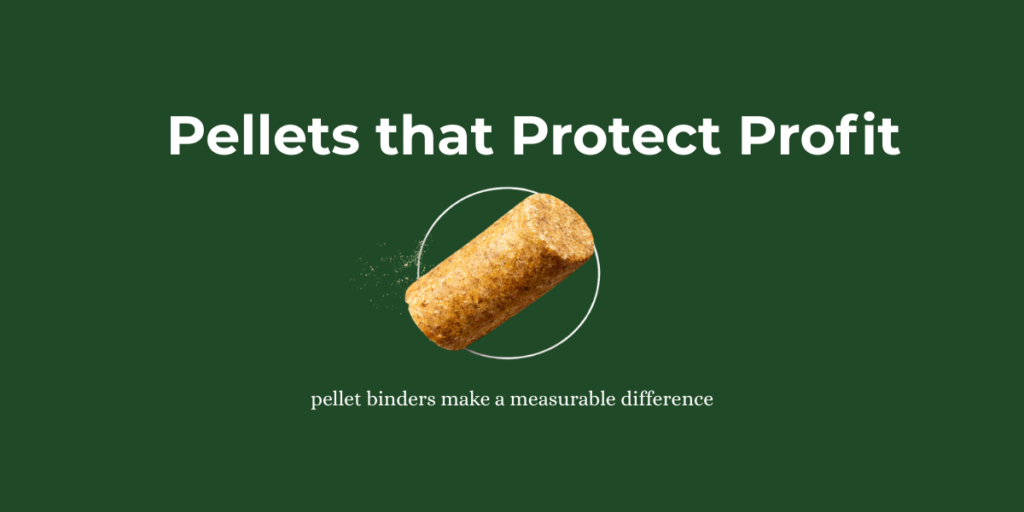
This is where pellet binders make a measurable difference.
What Is a Pellet Binder?
A pellet binder is a functional feed additive designed to improve the physical integrity of pellets. It works by strengthening the bonds between feed particles during pelleting, resulting in harder, more durable pellets.
Importantly, a pellet binder does not alter the nutritional value of the feed. Instead, it improves how nutrients are delivered, ensuring they remain intact from the mill to the animal.
How Pellet Binders Improve Feed Quality
Stronger pellets, fewer fines
Pellet binders increase particle bonding, producing harder and more durable pellets. This reduces breakage during cooling, transport, and handling, lowers dust and fines, and improves feed intake and uniformity, particularly in poultry and aqua feeds.
Uniform nutrient delivery
When pellets remain intact, animals receive a consistent nutrient profile with every bite. This minimizes intake variation and supports better growth, feed efficiency, and overall performance across species.
Better feed hygiene
Reduced dust helps limit mold growth and microbial contamination. While pellet binders are not a replacement for a toxin binder for poultry or livestock, improved pellet integrity reduces conditions that favor contamination and supports safer feed handling.
How Pellet Binders Improve Mill Efficiency
Pellet binders do not benefit the animal alone. They also improve operational efficiency inside the feed mill.
Improved throughput and press capacity
By enhancing particle binding and lubrication inside the die, pellet binders reduce resistance and allow smoother pellet flow. This increases tons per hour and improves mill output without additional capital investment.
Reduced die and roller wear
Lower friction during pelleting extends die life, reduces roller slippage, and decreases maintenance frequency. Over time, this leads to significant savings in operational and replacement costs.
Lower energy consumption
Smoother pelleting reduces motor load and power usage per ton of feed. In high-volume mills, this translates into meaningful energy cost savings.
Greater formulation flexibility
Pellet binders allow mills to include dusty or challenging raw materials while maintaining pellet quality. This flexibility enables the use of alternative, cost-effective ingredients during periods of raw material price volatility.
Choosing the Right Pellet Binder
Not all pellet binders perform the same way. Their effectiveness depends on:
- Source and composition, such as starch-based, gum-based, or fiber-based binders
- Compatibility with pelleting temperature and moisture
- Consistent performance across different formulations
Access to technically sound pellet binders, typically developed by an established Animal Feed Additives Manufacturer, helps ensure reliable quality and suitability across multiple feed types and species.
How to Use Pellet Binders Effectively
Step 1: Identify the problem clearly
Determine whether the issue is high fines, low PDI, die choking, or low throughput. Understanding the bottleneck helps define the correct inclusion strategy.
Step 2: Standardize inclusion
Pellet binders perform best when used consistently, mixed properly, and supported by correct conditioning temperature and moisture levels.
Step 3: Monitor mill and feed performance
Track key indicators such as pellet durability, fines percentage, power consumption, and animal feed intake. These parameters help quantify the true return on investment.
Pellet Quality Is Not Optional
Pellet binders may seem like a small addition, but their impact is far-reaching. They improve feed quality, reduce wastage, protect nutrients, and enhance feed mill efficiency.
In modern feed manufacturing, pellet binders are no longer just processing aids. They are profit protectors, benefiting both the mill and the animal. When feed holds together better, performance, efficiency, and profitability naturally follow.